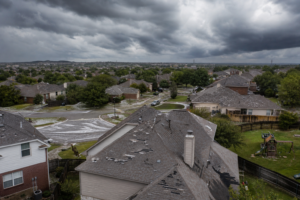
A hail storm rolls through San Marcos or Kyle, you go outside the next morning, and the neighborhood looks… fine. Your car doesn’t have dents. Your windows are intact. You check the roof from the driveway and can’t see anything obviously wrong. So it’s probably fine, right?
Maybe. But hail damage to a roof doesn’t always look like what you’d expect. And the damage that’s hardest to see from the ground is often the damage that causes the most trouble over the following months.
What Hail Actually Does to a Roof
Hail damage depends on hail size, density, angle, and wind speed at impact. Small hail (under an inch in diameter) can still strip protective granules from asphalt shingles. Larger stones — anything above an inch and a half — can crack shingles, puncture them, or cause bruising that compromises the mat underneath even when the surface looks intact.
The visible granule loss is the most common sign on asphalt shingles. Granules are the protective coating that shields the asphalt from UV radiation and rain. When hail knocks them loose, it accelerates the aging of the shingle in that spot. You won’t see a leak right away. But you’ve created a vulnerability that gets worse with each subsequent storm and each season of Texas sun.
What to Look for on Asphalt Shingles
- Granule loss and bare spots. Random circular or impact-shaped spots where the granules have been stripped, revealing the darker asphalt mat beneath.
- Bruising. Soft spots on shingles that feel like the bruise on a piece of fruit when pressed — the fiberglass mat beneath the asphalt has been compromised. This one requires getting on the roof to find.
- Cracked shingles. Larger hail can crack shingles completely. You may see this from the ground or from the gutters.
- Granules in gutters and downspouts. After a storm, if you’re seeing an unusual volume of granules collecting in your gutters, that’s a direct indicator of impact.
What to Look for on Metal Roofing
Metal roofs don’t lose granules, but hail leaves a different calling card: dents. Small hailstones leave small, shallow dents. Larger stones can leave more significant depressions. The question for insurance purposes is whether the denting is cosmetic or functional. A qualified inspector can distinguish between the two — surface dimpling that doesn’t compromise the roof’s waterproofing versus damage that affects the integrity of the panels or coatings.
What to Look for on Tile Roofing
Clay and concrete tile can crack or chip under hail impact. Cracks in tile are serious because water infiltrates through even a small fracture and can cause damage to the underlayment and decking below. Cracked tiles aren’t always visible from the ground, particularly on steeper pitches.
Why You Shouldn’t Wait to Get It Checked
Two things happen when hail damage goes uninspected after a storm.
First, the damage compounds. A stripped or bruised shingle in August is going to face months of Texas UV before the next inspection opportunity. The water intrusion risk grows.
Second, insurance claims become harder to support. Most Texas homeowners insurance policies require claims to be filed within a reasonable time of the damage event. If you wait a year and then discover damage, it becomes difficult to prove whether the damage occurred in last spring’s hail event or an earlier one — or whether general wear and aging contributed. Adjusters look for that opening, and they find it in delayed claims.
Getting a professional inspection shortly after a significant storm protects both your roof and your claim timeline.
Why DIY Inspection Has Real Limits
You can check your gutters for granule accumulation. You can look for missing shingles from the ground. But hail damage that affects the integrity of the shingles without obvious visible signs — bruising, hairline cracks, early granule loss on upper slopes — requires getting on the roof and knowing what to look for.
Divided Sky’s inspectors have evaluated hundreds of roofs after Central Texas hail events. We know what storm damage looks like versus normal wear, and we document everything in a way that supports your insurance claim if the damage warrants it.
After any significant hail event in San Marcos, Kyle, New Braunfels, Buda, or the surrounding area, schedule a free inspection. There’s no cost, no obligation, and no guessing about what’s actually on your roof.
