Most homeowners file one or two insurance claims in their lives. Most roofers have filed hundreds. That experience gap matters more than most people realize — especially in the months after a hail storm, when the difference between a smooth claim and a frustrating one often comes down to how the damage was documented before the adjuster arrived.
This is not about gaming the system. It is about understanding how the system works, so you are not starting from behind.
How a Roofing Insurance Claim Actually Works
The process looks like this:
- A storm event occurs
- You notice or suspect damage
- You file a claim with your insurer
- An insurance adjuster schedules an inspection
- The adjuster assesses damage and generates a scope of loss
- You receive an estimate and a check for the actual cash value of the damage (minus your deductible)
- You select a contractor, begin work, and your contractor invoices the insurer for the full replacement cost value once the job is complete
That is the simplified version. Here is where it gets complicated in practice.
The Adjuster Is Not Your Advocate
Insurance adjusters are professionals doing a job, and most of them do it honestly. But they work for the insurer, not for you. Their job is to assess damage accurately per your policy terms — which means they are not looking to find more damage. They are looking to document what they can verify.
If your roof has hail impacts that are subtle — if the granule loss is significant but not dramatic, or if the mat damage is real but not visible to a quick visual scan — it may not make it into the adjuster’s scope. Not because they are cutting corners, but because they moved through your roof in 20 minutes and did not have the context a roofer does.
This is why having a roofing contractor present during the adjuster inspection is standard practice for homeowners who want a complete picture. A GAF Master Elite contractor can point to specific damage patterns and explain the technical implications in terms an adjuster can document. That is not advocacy — that is technical translation.
What Gets Missed Most Often
In Divided Sky’s experience across hundreds of Hays County and Comal County claims, these are the items that get underreported most consistently:
- Pipe boot damage — Rubber pipe boots crack from hail impact. They are small, high on the roof, and easy to miss on a quick walk. A cracked pipe boot will leak.
- Ridge cap damage — Ridge caps sit at the highest exposure point on the roof. They take more direct hail contact than field shingles. They are also the first place Tom Marshall looks after a storm.
- Flashing failure — Metal flashing at valleys, chimneys, and skylights dents from hail. Dented flashing lifts at the edges. Lifted flashing allows water infiltration. It is a line-item on every Divided Sky post-storm report.
- Gutters and downspouts — Hail-dented gutters are physical evidence of storm severity. They document that the hail was large enough and numerous enough to leave marks on metal. Adjusters who miss gutters miss corroborating evidence for the roof claim.
- Interior follow-up — If moisture has already reached the decking, there may be interior evidence: staining, soft spots in ceiling drywall, or elevated readings on a moisture meter. Documenting this before the adjuster arrives strengthens the claim significantly.
Your Deductible Is Your Responsibility — Everything Above It Is Not
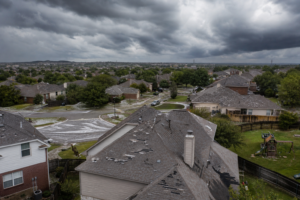
A note on what is standard and what is not: your deductible is your portion of the claim. Full stop. Any contractor who offers to “waive your deductible” is describing insurance fraud. It is also a red flag about how they operate in general.
Divided Sky does not waive deductibles. We also do not tell you whether to file a claim — that is your decision, based on your policy, your deductible amount, and your assessment of the damage. What we do is give you the information you need to make that decision: a thorough inspection report, a clear explanation of what we found, and a straightforward answer to the question of whether what we found is worth pursuing.
Timeline: When to Act
Most Texas homeowners insurance policies require storm damage to be reported within one year of the event. Some are shorter. Check your policy language — specifically the “prompt notice” or “timely reporting” clause.
The practical timeline: get an inspection within 30 days of the storm. File the claim if warranted. Most claims move to adjuster inspection within two to four weeks of filing. The full process from storm to settlement typically runs 60 to 90 days for uncomplicated residential claims.
Waiting until fall to deal with a spring storm’s damage is how legitimate claims become borderline ones.
Divided Sky Roofing & Solar serves San Marcos, Kyle, Buda, New Braunfels, Wimberley, Dripping Springs, and the surrounding Central Texas area. We offer free post-storm inspections and work alongside homeowners through the claims process when they want us there. Schedule at stg-dividedskyroofingandsolar-staging.kinsta.cloud/contact or call (512) 995-7663.
