The storm rolled through. The sky went green, the hail came sideways, and then it was over. Now you’re standing in your yard, looking up, trying to figure out if your roof is okay.
Here’s the honest answer: you probably can’t tell from down there.
Hail damage to a roof is deceptive. From the ground, a damaged roof looks exactly like a fine roof. The dents are on the surface of the shingles — small, dark spots that are nearly impossible to see without climbing up and knowing what you’re looking for. By the time the damage is obvious from the street, it’s been letting water in for a while.
What Hail Actually Does to a Shingle
Asphalt shingles have a layer of granules on the surface — those small, sand-like particles that give shingles their texture and color. The granules are the UV protection. They’re also the weather barrier.
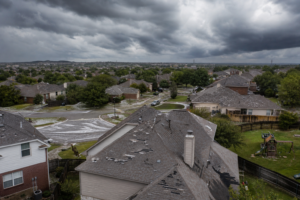
When hail hits a shingle, it knocks the granules loose. The impact point becomes a small, exposed patch of asphalt. You can feel it if you run your finger across it — a soft, bruised divot. What you’ll see in your gutters after a storm is a surge of granules washing out. That’s not normal wear. That’s the storm accelerating your roof’s aging by years in a single afternoon.
Larger hail — golf ball size or bigger — can crack shingles outright. That kind of damage shows up faster. But quarter-size hail, which is common in Hays County and Comal County storms, causes the slow kind of damage. It compromises the shingle without cracking it. The roof looks intact. Water finds its way in eventually.
The Signs That Are Actually Worth Checking
You don’t need to get on the roof to do an initial check. Here’s what to look at from safe ground:
- Your gutters and downspouts. After a significant storm, check the gutters. If you see an unusual amount of granules — dark, gritty material that looks like coarse sand — your shingles took a hit.
- Your AC unit and any skylights. Hail dents soft metal. If your AC condenser fins are dented, your roof was in the same storm. They’re a useful indicator before you call anyone.
- Your fence or deck. Bare wood will show impact marks from hail. If the wood shows circular dents or spatter marks, the storm was hard enough to do roof damage.
- Any exposed flashing. Metal flashing around chimneys, vents, or valleys is easier to read than shingles. Dents show clearly. If flashing is dented, shingles likely took the same hits.
None of these are a substitute for an actual roof inspection. But they give you a read on whether the storm was significant before you pick up the phone.
Why It Matters to Know Quickly
Hail damage that goes unaddressed doesn’t stay minor. A compromised shingle absorbs water differently than an intact one. Over weeks and months, that moisture works its way into the decking. What started as granule loss becomes a soft spot in the roof structure. What would have been a repair becomes a replacement.
Central Texas storms don’t happen in isolation. If your roof was weakened in a May storm, it goes into the summer heat already compromised. Thermal expansion and contraction do their work all summer. By fall, that damage has progressed.
An inspection after a significant storm costs you nothing but an hour. The alternative — finding out about the damage after a leak appears — costs considerably more.
What a Real Inspection Looks Like
A thorough post-storm inspection covers the whole roof system, not just the shingles. That means:
- Checking shingle condition across all roof planes, including areas that face different wind directions (they take different impacts)
- Inspecting all flashing points — chimneys, vents, valleys, skylights
- Checking ridge caps, which take direct hits and are often the first to show damage
- Looking at gutters and fascia for structural damage
- Assessing the decking condition where possible
- Documenting what was found with photos
At Divided Sky, we’re a GAF Master Elite Contractor — a designation held by fewer than 3% of roofing contractors in North America. It means our inspectors know what storm damage actually looks like versus normal wear, and they can tell you honestly which is which.
If the storm was minor and your roof is fine, we’ll tell you that. If there’s damage, we’ll show you exactly what we found and walk you through what it means for your roof’s lifespan.
If You’re in Central Texas and You Caught That Storm
We serve San Marcos, Kyle, Buda, New Braunfels, Wimberley, Dripping Springs, and the surrounding area. Storm season in Central Texas doesn’t announce itself — a clear morning can turn into a hail event by afternoon. If your area got hit, a free inspection is the fastest way to know where you stand.
Call us at 512-995-7663 or schedule online at stg-dividedskyroofingandsolar-staging.kinsta.cloud. No pressure, no commitment — just a clear answer about your roof.
