Most homeowners don’t think about attic ventilation until something goes wrong. By that point, the damage is done. In Central Texas, where summer attic temperatures can exceed 150 degrees Fahrenheit, poor ventilation is one of the most expensive silent problems in residential roofing.
Here’s what’s actually happening up there and why it matters.
What Happens to an Under-Ventilated Attic in a Texas Summer
When outside temperatures hit 95 to 100 degrees and your attic has inadequate airflow, heat builds inside the attic space rapidly. On a typical Texas summer afternoon, a poorly ventilated attic can reach 150 to 160 degrees Fahrenheit. That heat does several things simultaneously.
It cooks the shingles from underneath. Shingles are rated for certain temperatures on their top surface. The underside isn’t built to absorb sustained extreme heat from below. Premature granule loss and shingle degradation are direct consequences. A roof that should last 25 to 30 years in a temperate climate can underperform significantly in a Texas home with poor ventilation.
It forces your HVAC to work harder. Attic heat radiates into your living space. Your air conditioner has to remove that heat in addition to the heat coming through windows and walls. If you’ve ever wondered why your electric bill is higher than your neighbors’ even though you set the thermostat the same, attic ventilation is worth investigating.
It can cause moisture problems. Temperature swings between hot days and cooler nights create condensation in attic spaces with inadequate airflow. Over time, that moisture damages decking, insulation, and framing.
What Good Ventilation Actually Looks Like
The standard is 1 square foot of net free ventilation area for every 150 square feet of attic floor space, balanced between intake (usually at the soffits) and exhaust (at the ridge or roof vents). The balance matters. All exhaust and no intake creates negative pressure that can pull conditioned air out of the living space. All intake and no exhaust leaves hot air trapped with nowhere to go.
Ridge vents paired with continuous soffit vents are the most effective passive system. They create a natural convective flow: cooler air enters at the soffits, rises as it heats, and exits at the ridge.
Solar-Powered Attic Fans
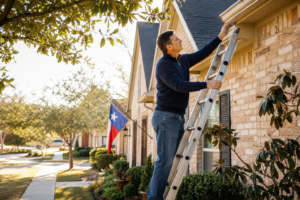
In extreme climates like Central Texas, passive ventilation is sometimes insufficient during peak summer heat. Solar-powered attic fans — Divided Sky installs Attic Breeze units — provide active ventilation powered by a small rooftop solar panel. No wiring required. No operating cost. They run when the sun is out, which is exactly when you need them.
For homes with complex attic geometry, multiple roof sections, or consistently high summer cooling bills, a solar attic fan can be a cost-effective addition to a passive ventilation system.
When to Get an Assessment
If your roof is more than 10 years old and has never had a ventilation assessment, it’s worth scheduling one. If your cooling bills are high relative to your neighbors and your home’s size, ventilation is worth investigating. If you’re planning a re-roof, ventilation should be part of the conversation before the materials get ordered.
Divided Sky assesses attic ventilation as part of our standard roof inspections across our Central Texas service area. Free, no obligation. Schedule here.
